Intranet Transformation For Mine Sites
Intranet Transformation For Mine Sites
Intranet Transformation For Mine Sites
Governed, searchable intranet for critical operations
Governed, searchable intranet for critical operations
YEAR
2025
DURATION
6 months
DURATION
6 months
INDUSTRY
Mining
PLATFORM
Sharepoint Online
PRODUCT TYPE
B2B (Enterprise Intranet)
TOOLS
Figma, Balsamiq, Sharepoint Online
TEAM
1 Product Designer, 1 BA, 3 Devs, SMEs, PM
MY ROLE
Product Designer
TEAM
1 Product Designer, 1 BA, 3 Devs, SMEs, PM
MY ROLE
Product Designer
MY ROLE
Product Designer
PROJECT OVERVIEW
PRODUCT TYPE
B2B (Enterprise Intranet)
TOOLS
Figma, Balsamiq, Sharepoint Online
TEAM
1 Product Designer, 1 BA, 3 Devs, SMEs, PM
MY ROLE
Product Designer
Overview
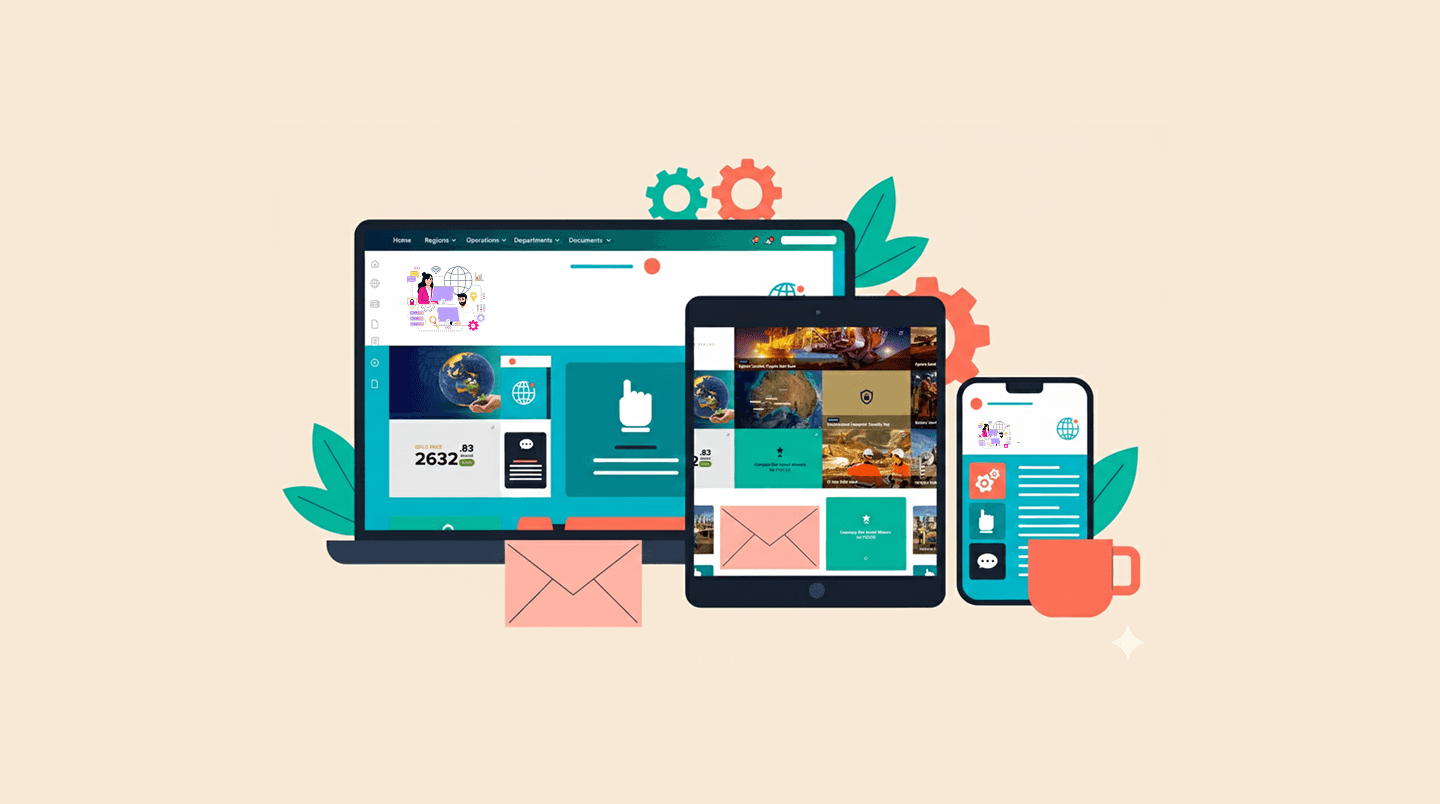
This project is a multi-site intranet transformation to standardise how mine sites search, publish, and find documents and trust operational information.
This solution focuses on governance (controlled publishing, permissions), findability (strong search, metadata), and operational usability, so frontline and office teams can reliably locate the right procedures, safety content, templates, and updates without hunting across disconnected team sites and folders.
Problem Statement
Mine-site and corporate employees cannot consistently find and trust critical operational information because content is fragmented across sites, poorly tagged, inconsistently governed, and search results are noisy or outdated. This creates operational friction and risk: teams waste time, rework tasks, follow outdated documents, and struggle to align with the latest approved guidance, especially during incidents, shift handovers, and urgent maintenance.
Business Goals & Challenges
Business Goals | Key Challenges/Constraints |
|---|---|
|
|
Target Audience
Corporate office staff (Head Office in Perth)
mine site operations teams
Contractors/vendors
Content owners/publishers
Success Metrics
Adoption & usage | Engagement |
|---|---|
↑ active users as a % of total employees (daily, weekly, monthly) | ↑ content interactions (likes/comments/shares) |
↑ login frequency, ↑ session duration | ↑ employee satisfaction/usefulness scores |
Productivity & efficiency | Content quality |
↓ time spent searching for information | ↑ % of documents current / up to date |
↓ internal email volume | ↑ content publishing frequency |
↑ faster onboarding for new employees | ↑ search success rate |
↑ support ticket deflection | ↓ broken links / outdated pages |
Overview
This project is a multi-site intranet transformation to standardise how mine sites search, publish, and find documents and trust operational information.
This solution focuses on governance (controlled publishing, permissions), findability (strong search, metadata), and operational usability, so frontline and office teams can reliably locate the right procedures, safety content, templates, and updates without hunting across disconnected team sites and folders.
Problem Statement
Mine-site and corporate employees cannot consistently find and trust critical operational information because content is fragmented across sites, poorly tagged, inconsistently governed, and search results are noisy or outdated. This creates operational friction and risk: teams waste time, rework tasks, follow outdated documents, and struggle to align with the latest approved guidance, especially during incidents, shift handovers, and urgent maintenance.
Business Goals & Challenges
Business Goals | Key Challenges/Constraints |
|---|---|
|
|
Target Audience
Corporate office staff (Head Office in Perth)
mine site operations teams
Contractors/vendors
Content owners/publishers
Success Metrics
Adoption & usage | Engagement |
|---|---|
↑ active users as a % of total employees (daily, weekly, monthly) | ↑ content interactions (likes/comments/shares) |
↑ login frequency, ↑ session duration | ↑ employee satisfaction/usefulness scores |
Productivity & efficiency | Content quality |
↓ time spent searching for information | ↑ % of documents current / up to date |
↓ internal email volume | ↑ content publishing frequency |
↑ faster onboarding for new employees | ↑ search success rate |
↑ support ticket deflection | ↓ broken links / outdated pages |
PRODUCT TYPE
B2B (Enterprise Intranet)
TOOLS
Figma, Balsamiq, Sharepoint Online
TEAM
1 Product Designer, 1 BA, 3 Devs, SMEs, PM
MY ROLE
Product Designer
IMPACT
IMPACT
If the new Intranets for Mine sites are implemented,
Teams can locate the right procedure or form in seconds, even under pressure, reducing downtime and rework.
A single governed source of truth improves compliance, reduces outdated document usage, and strengthens audit readiness.
Standardised IA + metadata improves cross-site alignment while preserving site context.
Clear publishing workflows create content accountability, increasing trust in the intranet.
Reduced support burden on admin/IT, enabling faster operations.
Business Impact
|
|
| ||||||
|
|
|



If the new Intranets for Mine sites are implemented,
Teams can locate the right procedure or form in seconds, even under pressure, reducing downtime and rework.
A single governed source of truth improves compliance, reduces outdated document usage, and strengthens audit readiness.
Standardised IA + metadata improves cross-site alignment while preserving site context.
Clear publishing workflows create content accountability, increasing trust in the intranet.
Reduced support burden on admin/IT, enabling faster operations.
Business Impact
|
|
| ||||||
|
|
|
PROJECT OVERVIEW
Overview
This project is a multi-site intranet transformation to standardise how mine sites search, publish, and find documents and trust operational information.
This solution focuses on governance (controlled publishing, permissions), findability (strong search, metadata), and operational usability, so frontline and office teams can reliably locate the right procedures, safety content, templates, and updates without hunting across disconnected team sites and folders.
Problem Statement
Mine-site and corporate employees cannot consistently find and trust critical operational information because content is fragmented across sites, poorly tagged, inconsistently governed, and search results are noisy or outdated. This creates operational friction and risk: teams waste time, rework tasks, follow outdated documents, and struggle to align with the latest approved guidance, especially during incidents, shift handovers, and urgent maintenance.
Business Goals & Challenges
Business Goals | Key Challenges/Constraints |
|---|---|
|
|
Target Audience
Corporate office staff (Head Office in Perth)
mine site operations teams
Contractors/vendors
Content owners/publishers
Success Metrics
Adoption & usage | Engagement |
|---|---|
↑ active users as a % of total employees (daily, weekly, monthly) | ↑ content interactions (likes/comments/shares) |
↑ login frequency, ↑ session duration | ↑ employee satisfaction/usefulness scores |
Productivity & efficiency | Content quality |
↓ time spent searching for information | ↑ % of documents current / up to date |
↓ internal email volume | ↑ content publishing frequency |
↑ faster onboarding for new employees | ↑ search success rate |
↑ support ticket deflection | ↓ broken links / outdated pages |
IMPACT
If the new Intranets for Mine sites are implemented,
Teams can locate the right procedure or form in seconds, even under pressure, reducing downtime and rework.
A single governed source of truth improves compliance, reduces outdated document usage, and strengthens audit readiness.
Standardised IA + metadata improves cross-site alignment while preserving site context.
Clear publishing workflows create content accountability, increasing trust in the intranet.
Reduced support burden on admin/IT, enabling faster operations.
Business Impact
|
|
| ||||||
|
|
|
RESEARCH
The research focuses on validating real operational tasks, high-risk content journeys, and governance friction points, so the intranet isn’t just "clean" but usable in the field and sustainable to manage.
Research Method | Purpose / Impact Supported | Actions Performed |
|---|---|---|
Stakeholder interviews | Align on business risk, governance requirements, success definition, and constraints |
|
Task analysis (top tasks) | Reduce time-to-find and task completion time by prioritising journeys that matter most |
|
Search log analysis | Improve search relevance and reduce failed searches |
|
Content audit | Improve trust and governance by cleaning and structuring the content set |
|
Card sorting | Validate IA so users can navigate without relying purely on search |
|
Usability testing (prototype) | Validate navigation, search, and content pages; reduce friction and errors |
|
SharePoint Online Web Parts Mapping - Research Variations
Web part | What it enables for users |
|---|---|
Hero web part | High-visibility promotions, key updates, featured destinations |
Quick Links web part | Fast self-serve access to high-frequency destinations |
News web part | Dynamic communications, announcements, and editorial content |
Events web part | Visibility of upcoming events; quick access to event details |
Microsoft 365 Calendar web part | Team-level calendar visibility without leaving the intranet |
Tasks web part | Personal task visibility and prioritisation from the homepage |
Document Library web part | Quick re-entry to active documents |
People web part | Highlights people, roles, recognition, or key contacts |
List web part | Curated, structured items displayed as a list |
Initial investigation of the current intranet
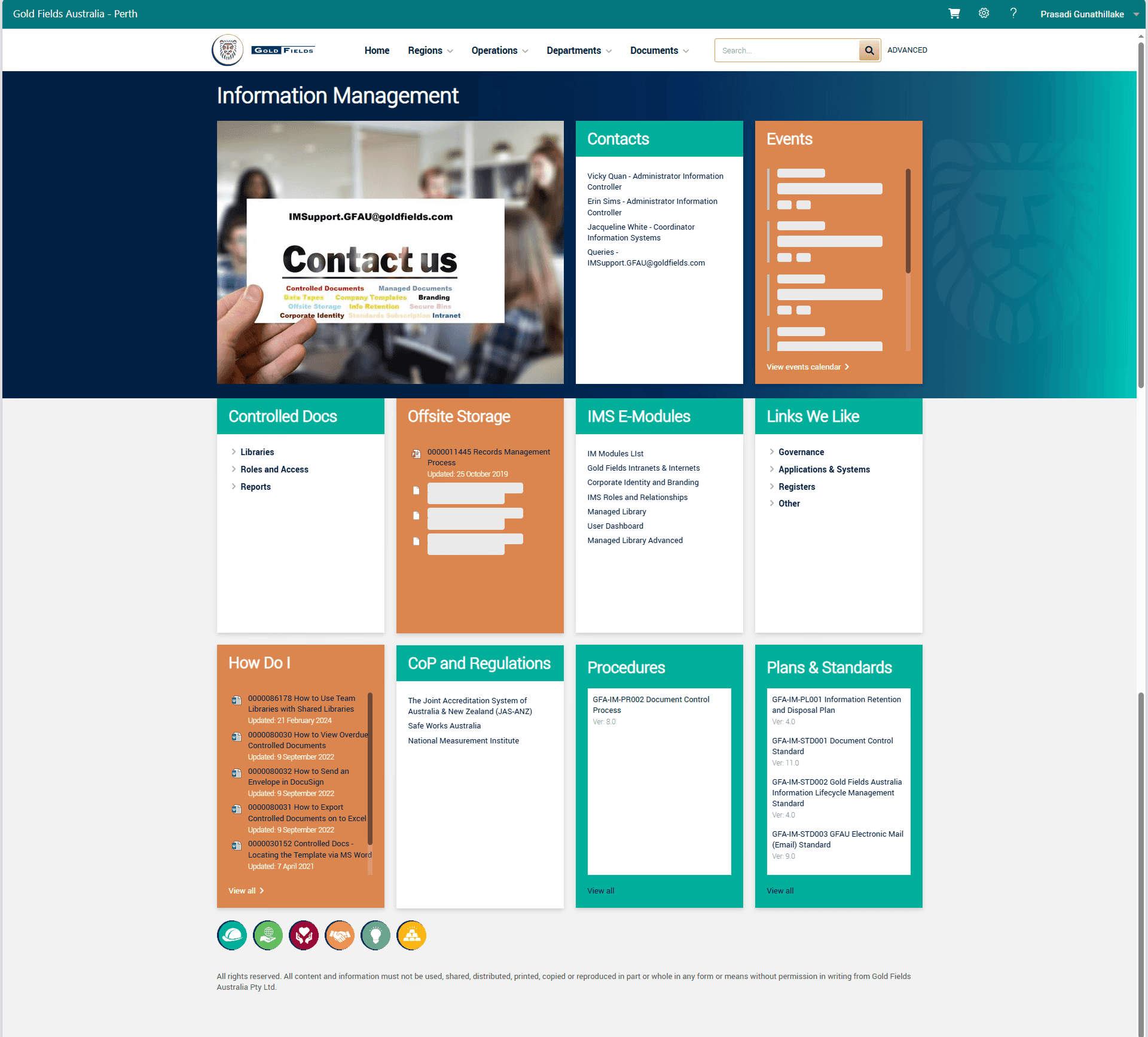
I conducted an initial investigation of the old intranet by reviewing the homepage layout, navigation model, and key content areas to understand how information was structured and how users were expected to complete common tasks.
I then mapped the end-to-end workflows and user journeys for high-frequency scenarios such as locating controlled documents, finding procedures and standards, accessing forms and e-modules, and contacting support.
This assessment was supported by a content and IA review to identify duplication, inconsistent labelling, and areas where users were forced to rely on browsing rather than efficient retrieval.
INSIGHTS
The review of the old intranet found several usability issues, including:
Too much reliance on tile-based navigation, with limited support for search
Unclear visual hierarchy across different modules
Long, dense lists that made content harder to scan
Inconsistent labels and content grouping
No personalisation to help users quickly return to their active work
Manual link maintenance, which made the system harder to scale as content grew
Other Insights
Research highlighted that employees rely on the intranet to find critical operational information quickly, yet the current experience often fails due to inconsistent navigation, duplicated or outdated content, and low trust in search results.
Below are the key behaviors and areas I considered when designing the new intranet to ensure it is easy to navigate, fast to search, trusted for critical information, and scalable across sites and teams.
Behaviours and areas | What I learned |
|---|---|
Search behaviour | Users start with a search, but frequently repeat searches because results feel unreliable. |
Time pressure | In high-pressure moments, users abandon after 2–3 failed clicks. |
High-frequency tasks | A small set of tasks drives most visits (forms, safety updates, contacts, service desk). |
Navigation inconsistency | Labels and structures vary across sites, creating hesitation and misclicks. |
Fragmented content | Duplicates and outdated versions exist across sites/libraries, causing confusion and rework. |
Tool switching | Users jump between SharePoint, Teams, and Outlook for meetings, tasks, and files. |
Personal re-entry | Users want a quick return to active items: recent documents, favourites, and teams. |
Support signals | Repeated “Where do I find…?” requests indicate weak self-serve pathways. |
DESIGN PROCESS
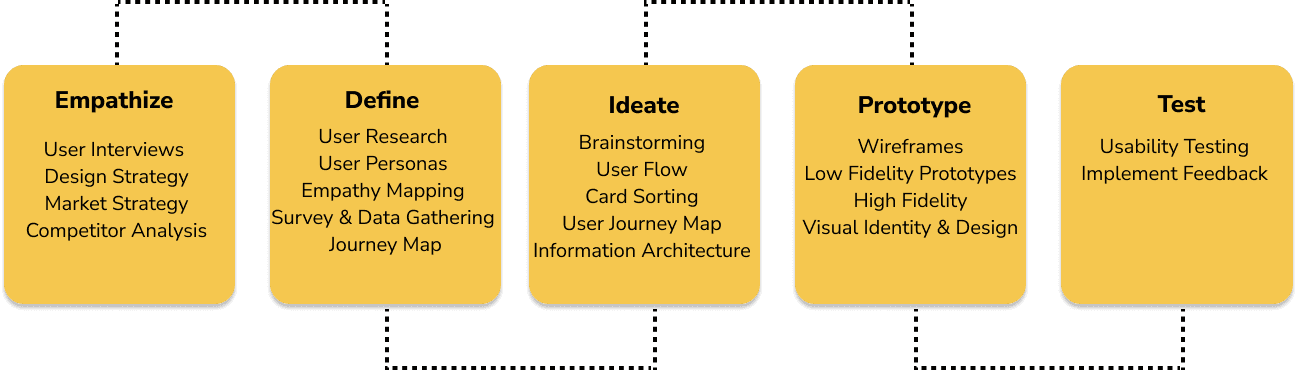
I followed a research-led, iterative design process to ensure the new intranet.
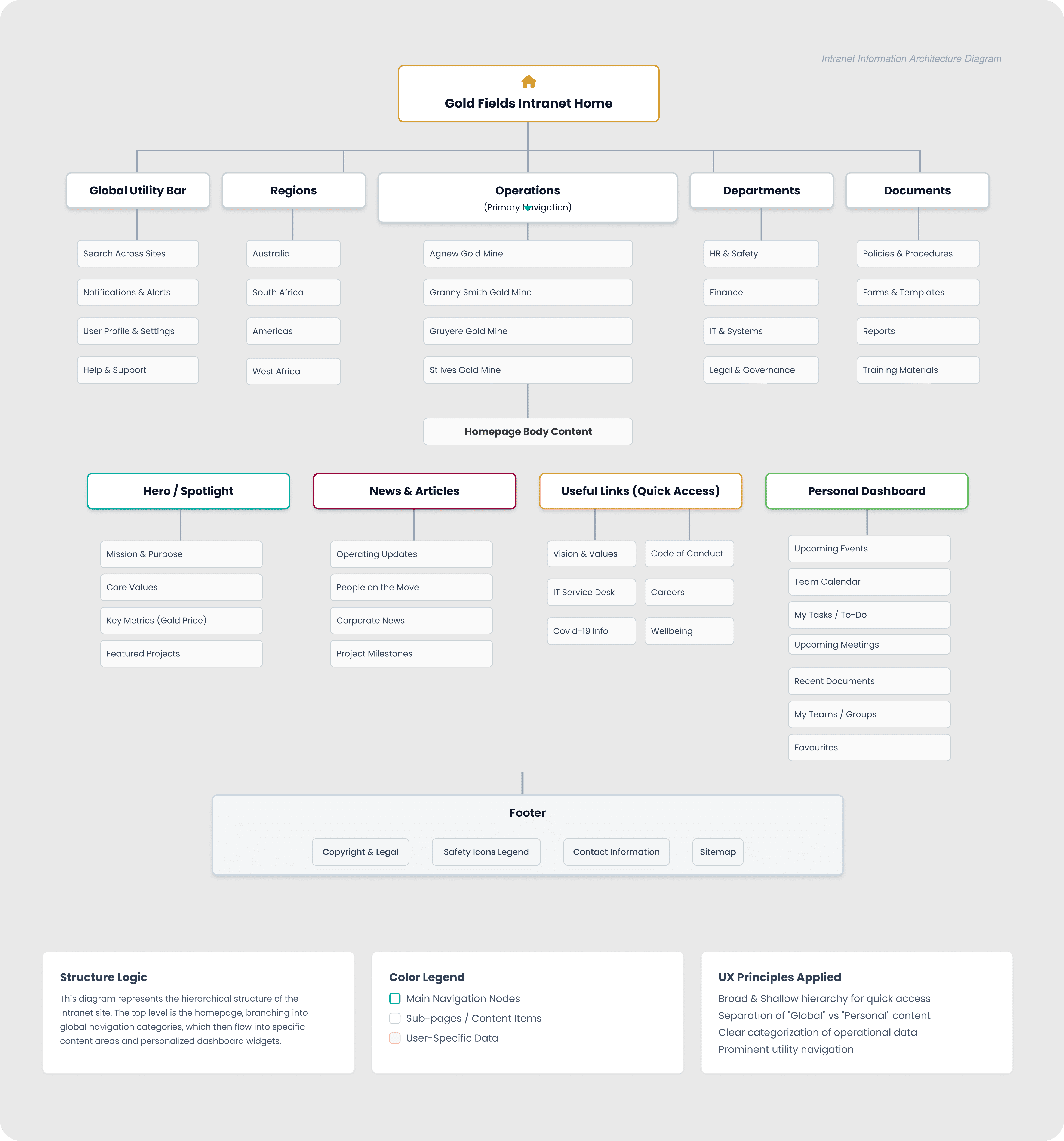
I first defined the information architecture by consolidating content domains, standardising global navigation across regions and mine sites, and establishing a consistent taxonomy and metadata model to improve findability and governance.
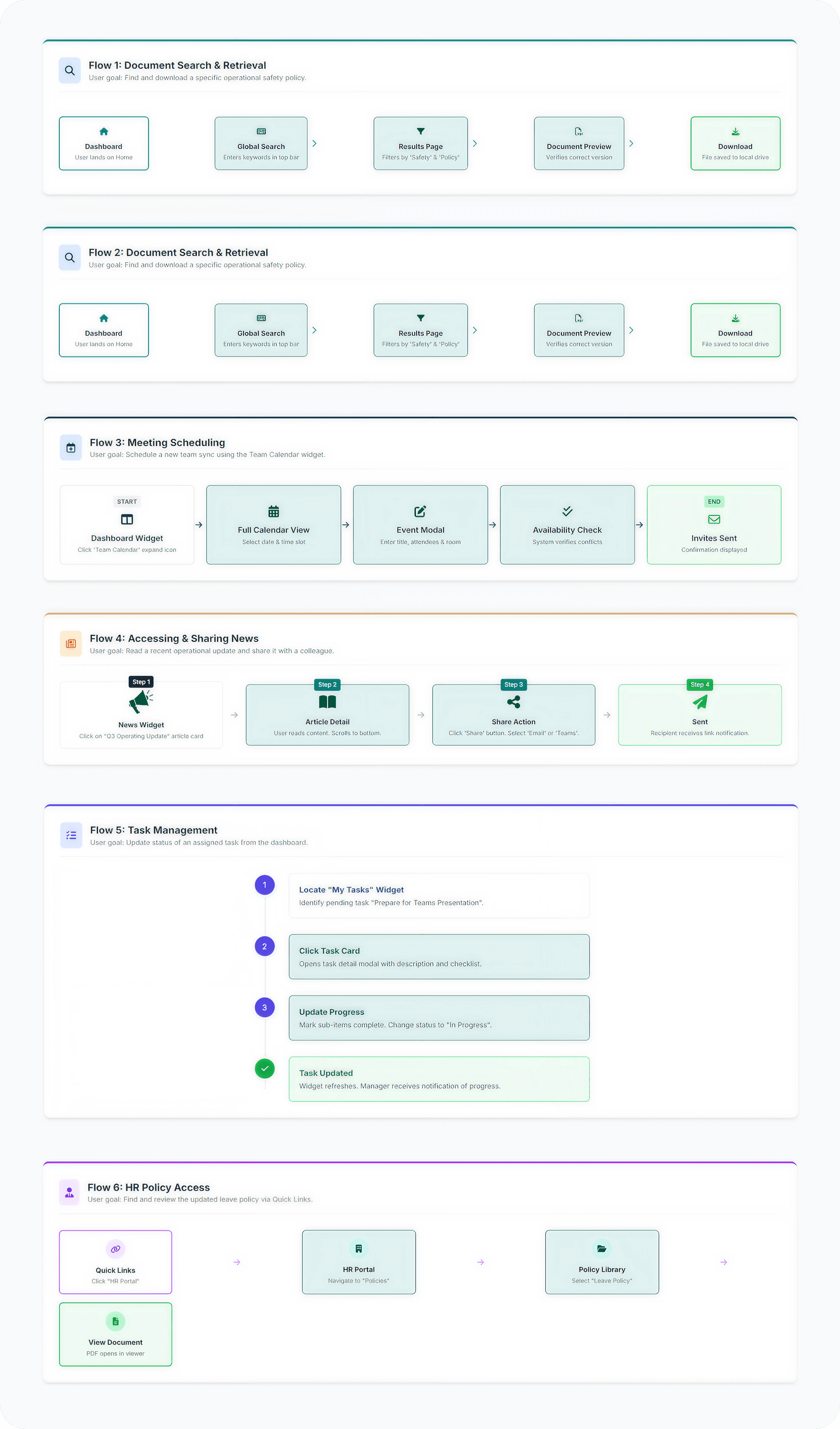
I then created task flows for the highest-frequency journeys to reduce steps, remove friction, and support time-critical use cases.
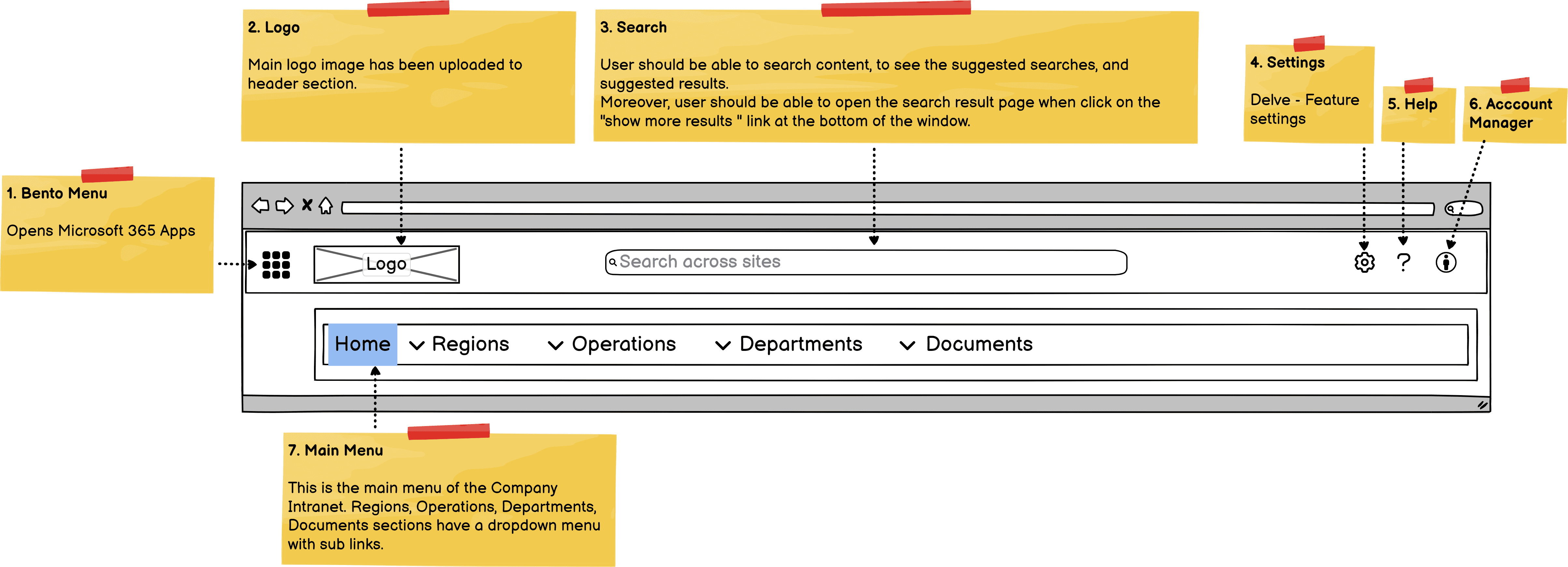
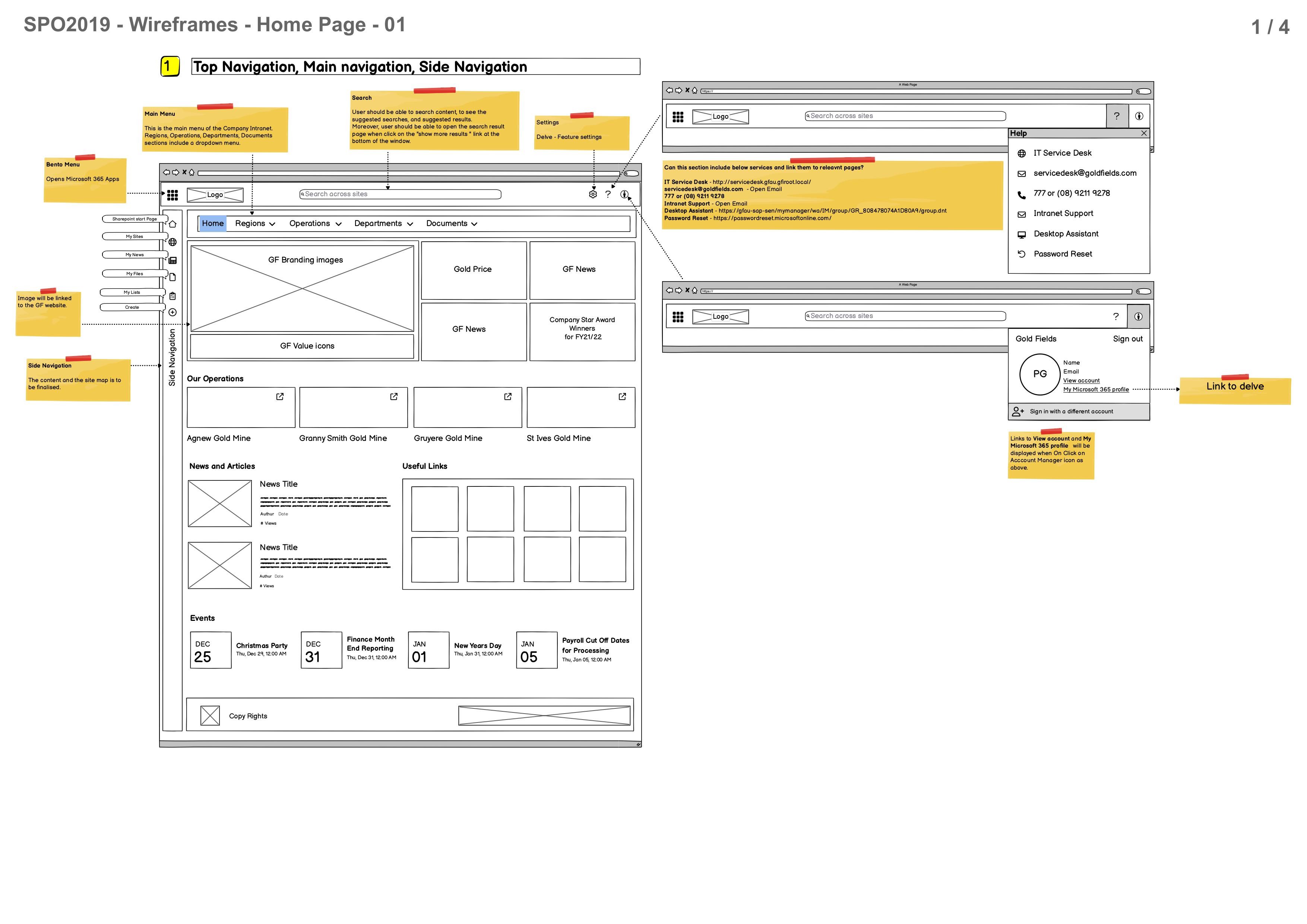
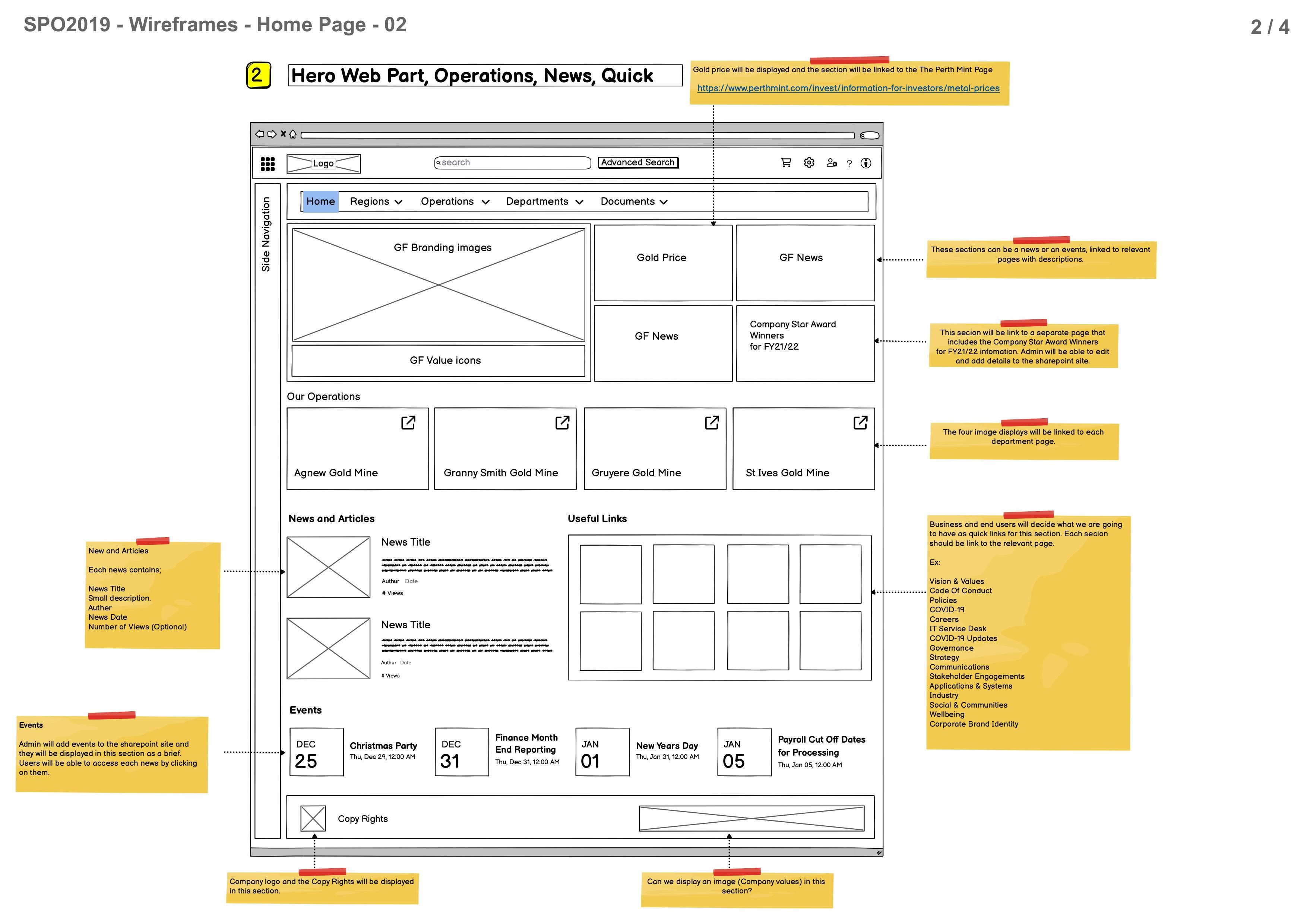
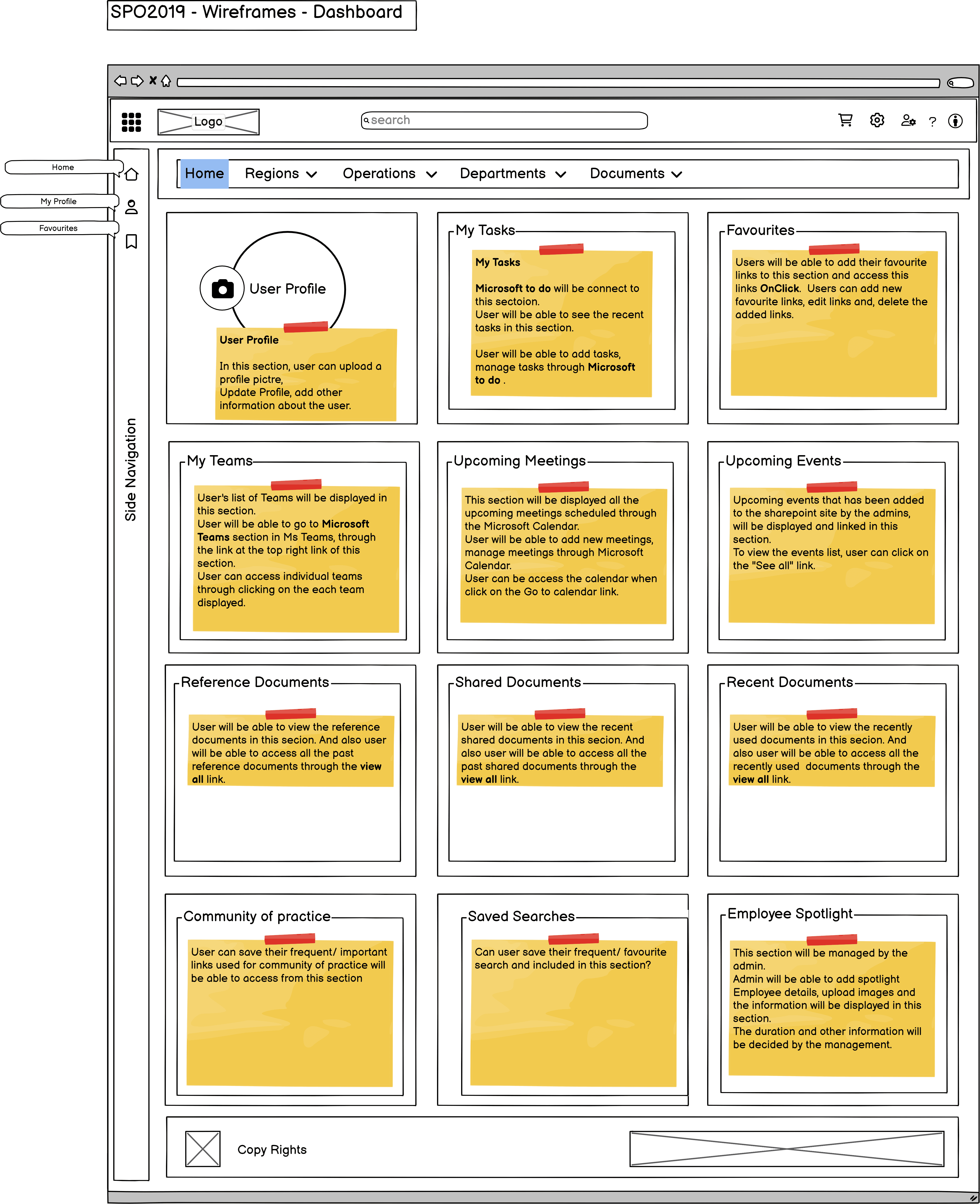
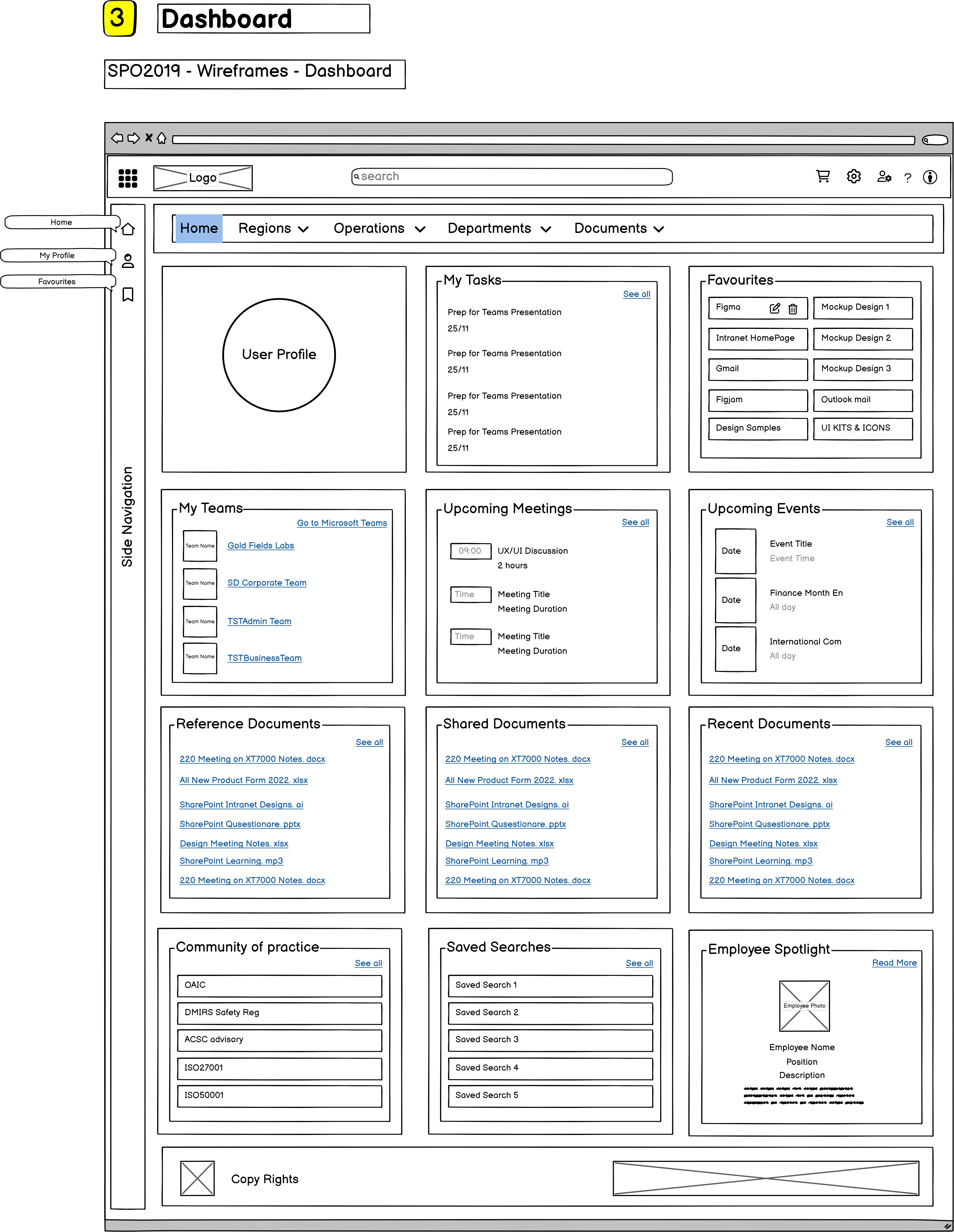
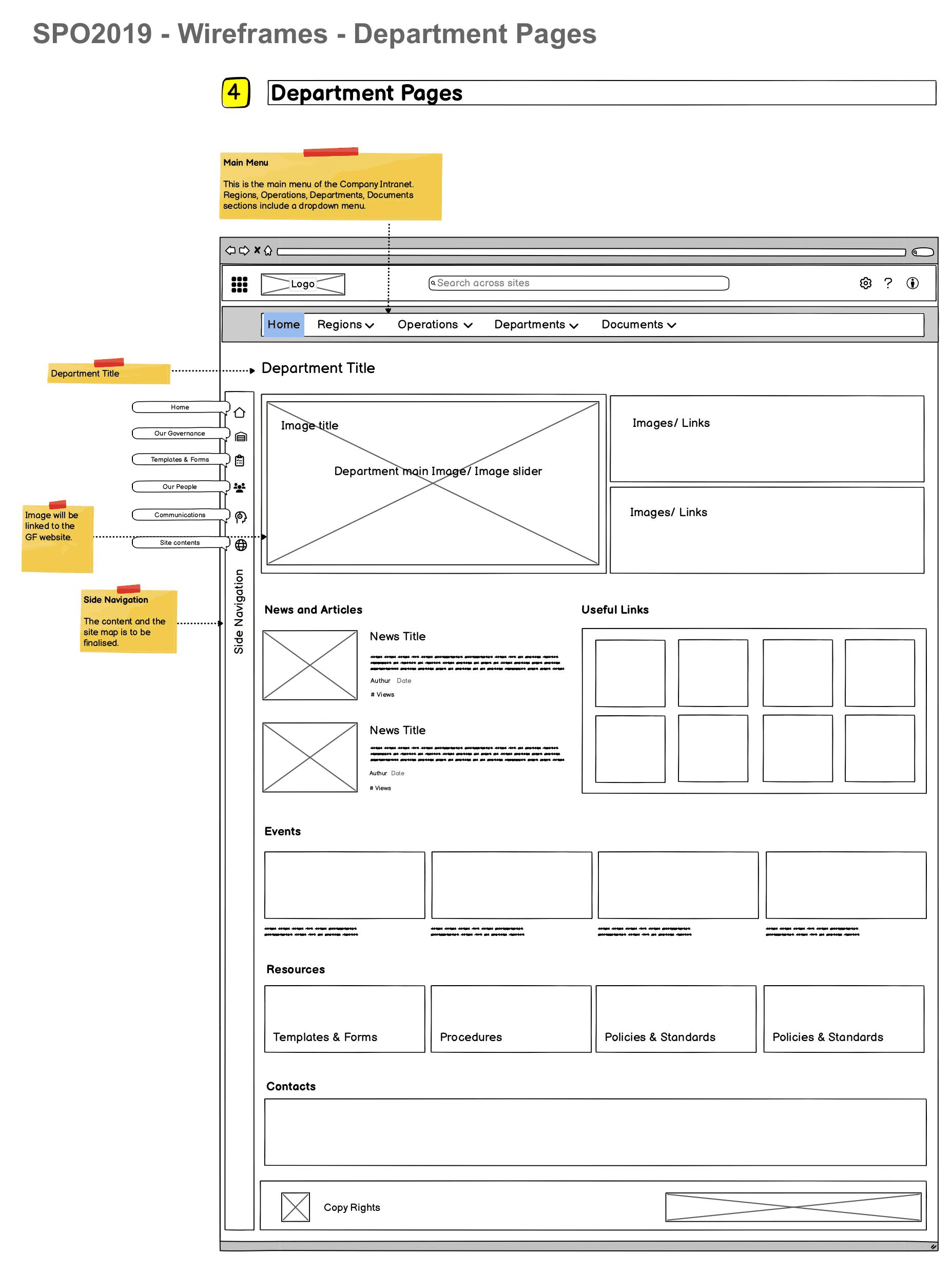
Next, I produced wireframes for core page templates, the homepage, site hubs, function hubs, search results, and document pages to validate hierarchy, scanning patterns, and access pathways early.
Finally, I developed interactive prototypes to test navigation, search behavior, and trust cues, and I iterated the experience based on usability findings to strengthen speed, clarity, and consistency across the intranet.
Design Process
Information architecture
Core operational workflows
Wireframes
Testing and iterations
I tested the design using an interactive prototype to validate key user journeys such as search, navigation to the site and function hubs, and locating controlled documents.
I observed task completion, time-to-find, and user confidence in content trust cues, then iterated the prototype based on findings.
These iterations simplified navigation labels, reduced page density, improved search filters and result clarity, and strengthened personalised re-entry through recent documents and favourites.
SOLUTION
This redesigned intranet delivers a modern, governed digital workplace for mine sites, built to make critical information easy to find, trust, and act on.
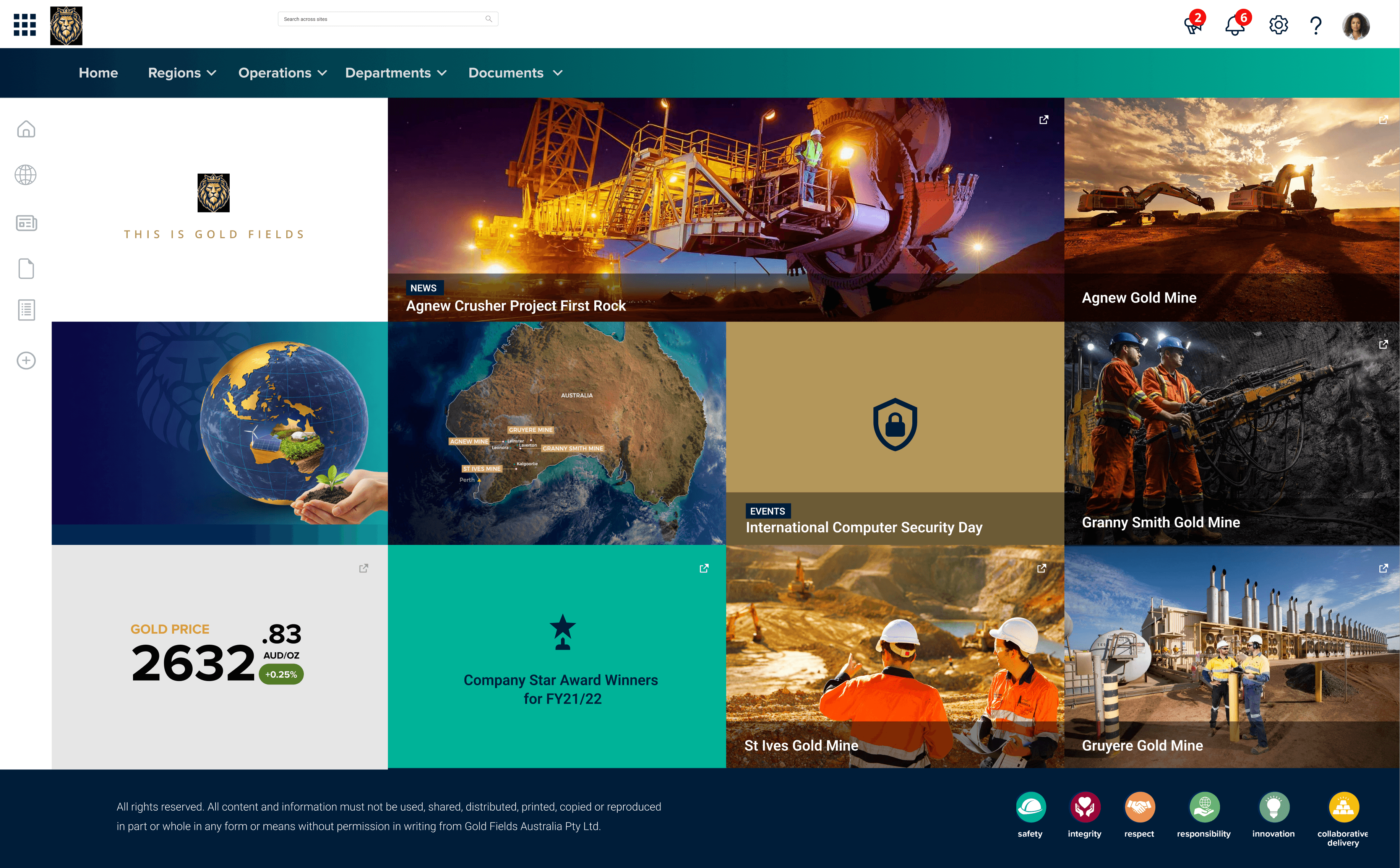
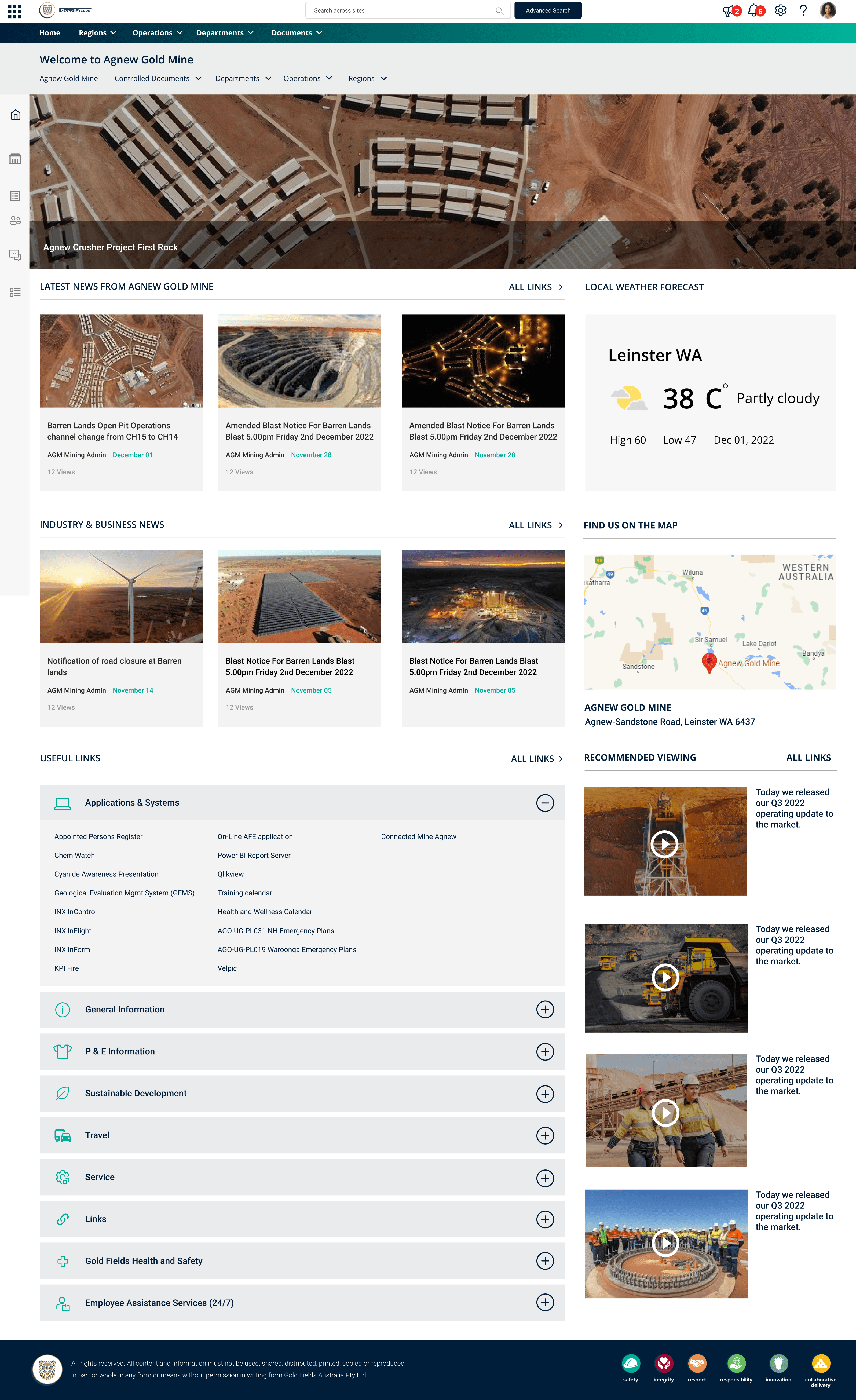
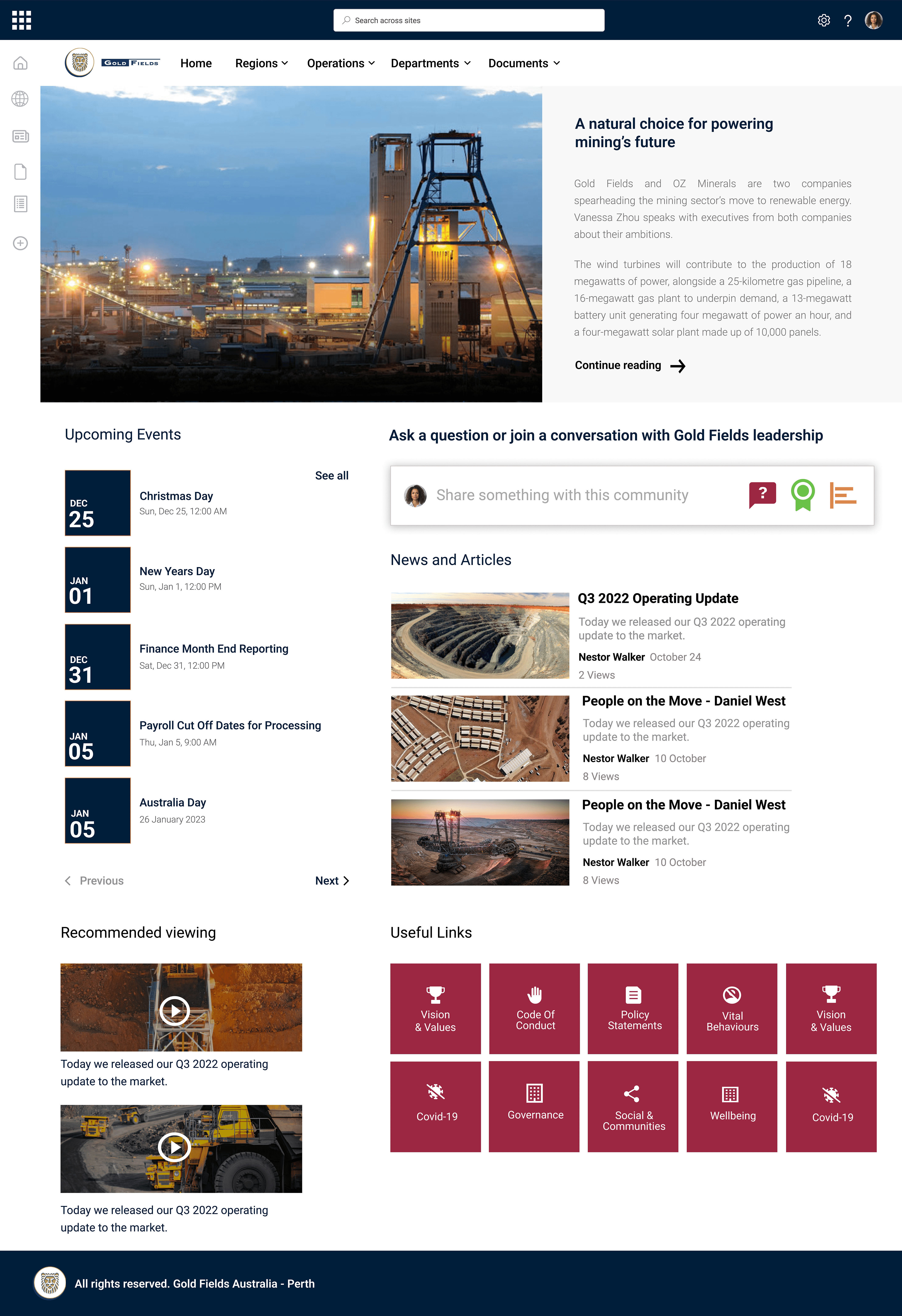
Below are some of the key design decisions made throughout the intranet redesign, reflected in the final screens and informed by iterative testing and refinement. These decisions focused on improving findability, trust, usability, and scalability across mine sites and corporate teams.
Design decisions

Final screens and Iterations
Perth Office - Home Page
Iteration 03

Iteration 02
Iteration 01
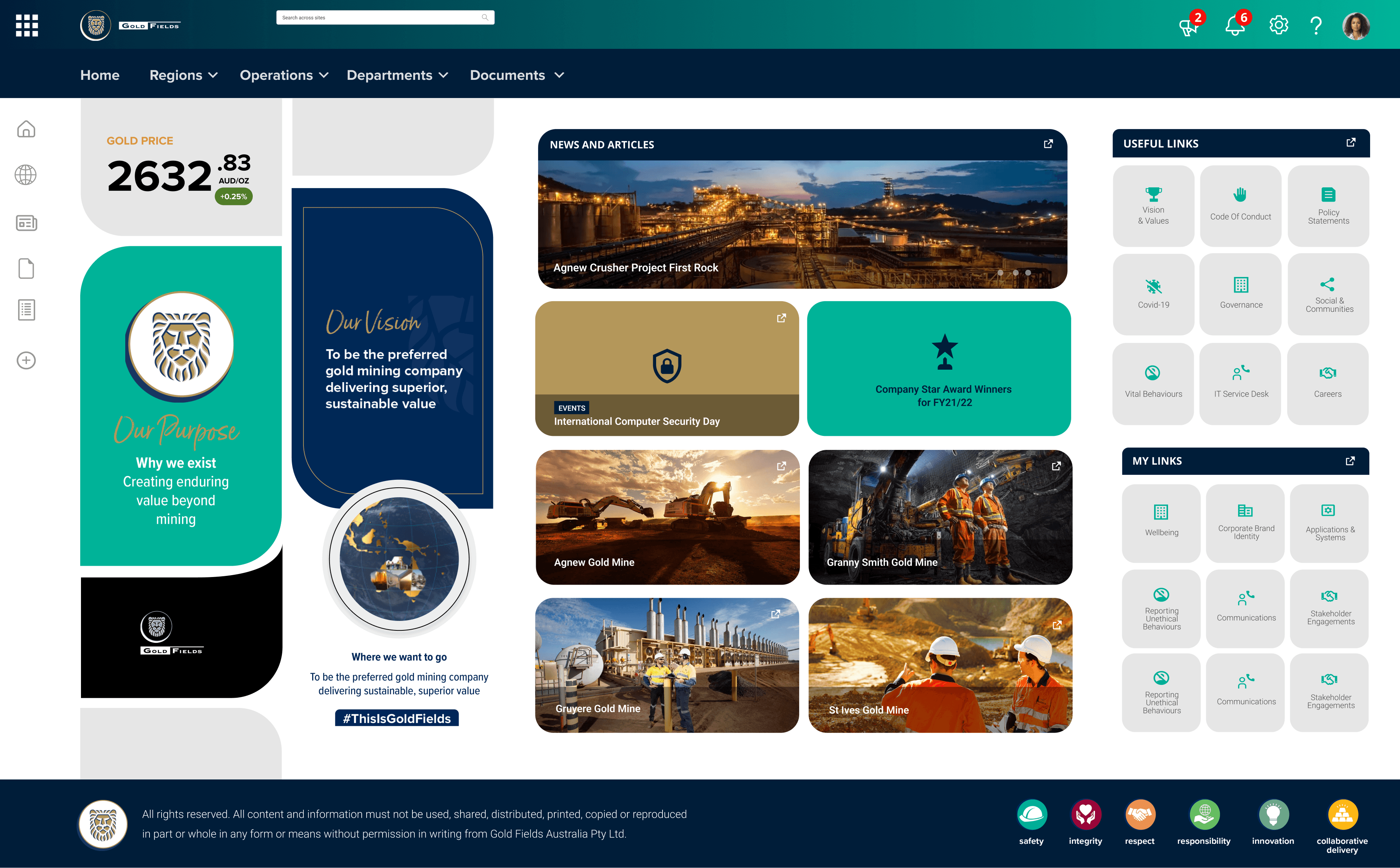
Gold Mine Site - Home Page
Perth Office - Home Page (Cloud Version)

Mine Site - Home Page


Dashboard
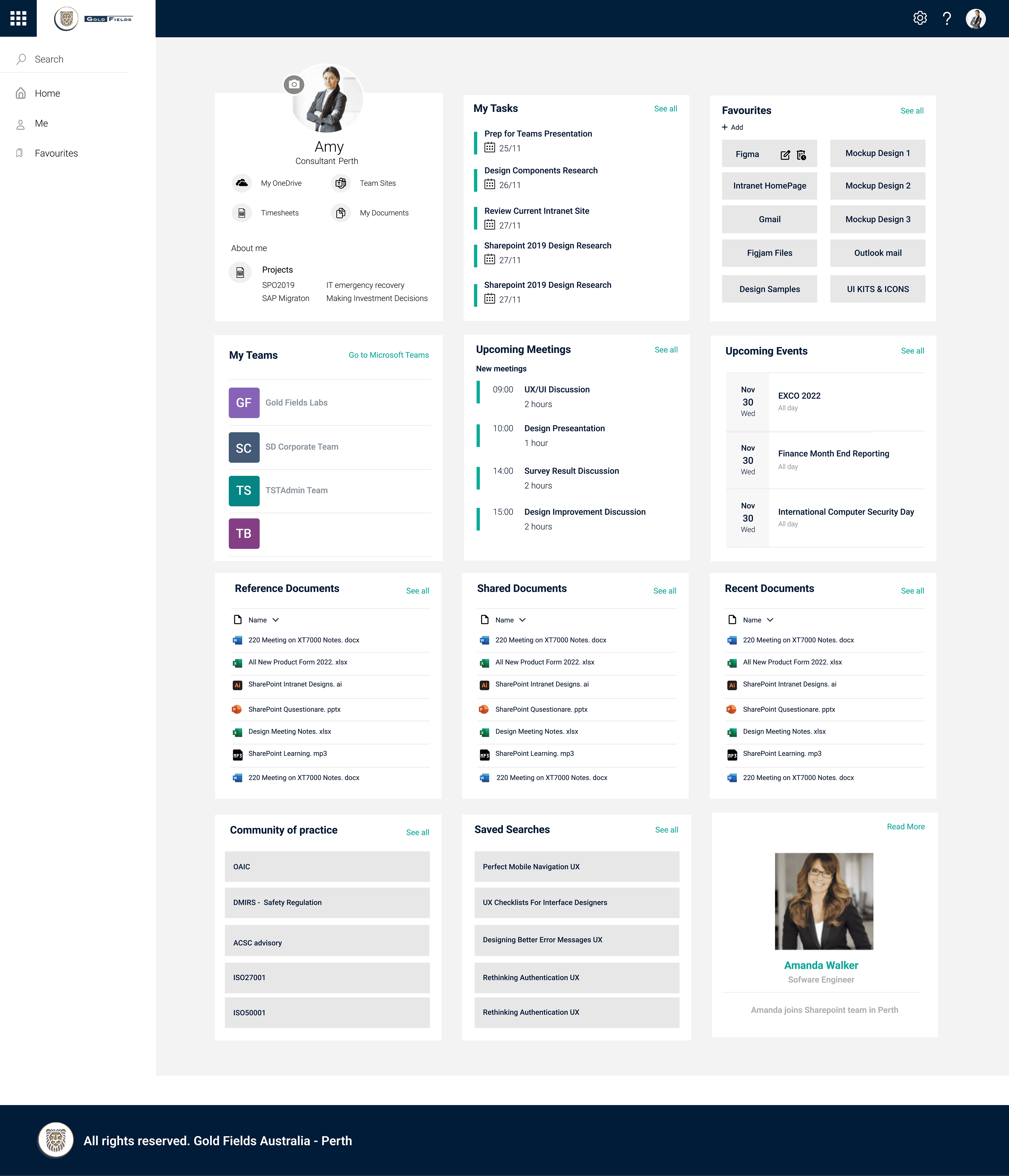
Improved workflow
The improved workflow streamlined how employees access and act on information by reducing navigation depth, prioritising search, and providing direct pathways to high-frequency tasks.
For content owners, a simplified publishing process with templates, mandatory metadata, and approval workflows improved consistency, currency, and governance, resulting in a faster, clearer, and more reliable intranet experience.
IMPACT/RESULTS
The impact analysis quantified measurable improvements such as reduced time-to-find critical information, fewer support requests, and increased self-serve completion of common tasks.
|
|
| ||||||
|
|
|
RESEARCH
The research focuses on validating real operational tasks, high-risk content journeys, and governance friction points, so the intranet isn’t just "clean" but usable in the field and sustainable to manage.
Research Method | Purpose / Impact Supported | Actions Performed |
|---|---|---|
Stakeholder interviews | Align on business risk, governance requirements, success definition, and constraints |
|
Task analysis (top tasks) | Reduce time-to-find and task completion time by prioritising journeys that matter most |
|
Search log analysis | Improve search relevance and reduce failed searches |
|
Content audit | Improve trust and governance by cleaning and structuring the content set |
|
Card sorting | Validate IA so users can navigate without relying purely on search |
|
Usability testing (prototype) | Validate navigation, search, and content pages; reduce friction and errors |
|
SharePoint Online Web Parts Mapping - Research Variations
Web part | What it enables for users |
|---|---|
Hero web part | High-visibility promotions, key updates, featured destinations |
Quick Links web part | Fast self-serve access to high-frequency destinations |
News web part | Dynamic communications, announcements, and editorial content |
Events web part | Visibility of upcoming events; quick access to event details |
Microsoft 365 Calendar web part | Team-level calendar visibility without leaving the intranet |
Tasks web part | Personal task visibility and prioritisation from the homepage |
Document Library web part | Quick re-entry to active documents |
People web part | Highlights people, roles, recognition, or key contacts |
List web part | Curated, structured items displayed as a list |
Initial investigation of the current intranet
I conducted an initial investigation of the old intranet by reviewing the homepage layout, navigation model, and key content areas to understand how information was structured and how users were expected to complete common tasks.
I then mapped the end-to-end workflows and user journeys for high-frequency scenarios such as locating controlled documents, finding procedures and standards, accessing forms and e-modules, and contacting support.
This assessment was supported by a content and IA review to identify duplication, inconsistent labelling, and areas where users were forced to rely on browsing rather than efficient retrieval.
INSIGHTS
The review of the old intranet found several usability issues, including:
Too much reliance on tile-based navigation, with limited support for search
Unclear visual hierarchy across different modules
Long, dense lists that made content harder to scan
Inconsistent labels and content grouping
No personalisation to help users quickly return to their active work
Manual link maintenance, which made the system harder to scale as content grew
Other Insights
Research highlighted that employees rely on the intranet to find critical operational information quickly, yet the current experience often fails due to inconsistent navigation, duplicated or outdated content, and low trust in search results.
Below are the key behaviors and areas I considered when designing the new intranet to ensure it is easy to navigate, fast to search, trusted for critical information, and scalable across sites and teams.
Behaviours and areas | What I learned |
|---|---|
Search behaviour | Users start with a search, but frequently repeat searches because results feel unreliable. |
Time pressure | In high-pressure moments, users abandon after 2–3 failed clicks. |
High-frequency tasks | A small set of tasks drives most visits (forms, safety updates, contacts, service desk). |
Navigation inconsistency | Labels and structures vary across sites, creating hesitation and misclicks. |
Fragmented content | Duplicates and outdated versions exist across sites/libraries, causing confusion and rework. |
Tool switching | Users jump between SharePoint, Teams, and Outlook for meetings, tasks, and files. |
Personal re-entry | Users want a quick return to active items: recent documents, favourites, and teams. |
Support signals | Repeated “Where do I find…?” requests indicate weak self-serve pathways. |
DESIGN PROCESS
I followed a research-led, iterative design process to ensure the new intranet.
I first defined the information architecture by consolidating content domains, standardising global navigation across regions and mine sites, and establishing a consistent taxonomy and metadata model to improve findability and governance.
I then created task flows for the highest-frequency journeys to reduce steps, remove friction, and support time-critical use cases.
Next, I produced wireframes for core page templates, the homepage, site hubs, function hubs, search results, and document pages to validate hierarchy, scanning patterns, and access pathways early.
Finally, I developed interactive prototypes to test navigation, search behavior, and trust cues, and I iterated the experience based on usability findings to strengthen speed, clarity, and consistency across the intranet.
Design Process
Information architecture
Core operational workflows
Wireframes
Testing and iterations
I tested the design using an interactive prototype to validate key user journeys such as search, navigation to the site and function hubs, and locating controlled documents.
I observed task completion, time-to-find, and user confidence in content trust cues, then iterated the prototype based on findings.
These iterations simplified navigation labels, reduced page density, improved search filters and result clarity, and strengthened personalised re-entry through recent documents and favourites.
SOLUTION
This redesigned intranet delivers a modern, governed digital workplace for mine sites, built to make critical information easy to find, trust, and act on.
Below are some of the key design decisions made throughout the intranet redesign, reflected in the final screens and informed by iterative testing and refinement. These decisions focused on improving findability, trust, usability, and scalability across mine sites and corporate teams.
Design decisions
Final screens and Iterations
Perth Office - Home Page
Iteration 03
Iteration 02
Iteration 01
Gold Mine Site - Home Page
Perth Office - Home Page (Cloud Version)
Mine Site - Home Page
Dashboard
Improved workflow
The improved workflow streamlined how employees access and act on information by reducing navigation depth, prioritising search, and providing direct pathways to high-frequency tasks.
For content owners, a simplified publishing process with templates, mandatory metadata, and approval workflows improved consistency, currency, and governance, resulting in a faster, clearer, and more reliable intranet experience.
IMPACT/RESULTS
The impact analysis quantified measurable improvements such as reduced time-to-find critical information, fewer support requests, and increased self-serve completion of common tasks.
|
|
| ||||||
|
|
|
NEXT STEPS
User testing and feedback
Conduct usability testing across mine-site and office roles to validate navigation, search, and key task journeys.
Run quick pulse surveys and targeted interviews to capture pain points, confidence, and adoption barriers.
Iterative design enhancements
Refine IA labels, hub layouts, and shortcuts based on testing insights and analytics.
Improve announcement targeting, notification rules, and homepage prioritisation to reduce noise and increase relevance.
End-to-end flow for future vision
Expand from the homepage into fully standardised site hubs and function hubs with consistent templates.
Add deeper lifecycle workflows to sustain content quality.
KEY TAKEAWAYS
Designing for speed, trust, and real work.
It was a privilege to work on an intranet transformation that directly supports critical mine-site operations, where finding the right information quickly is not a convenience but a necessity.
The main lesson I learned through this work is that a successful intranet is built through collaboration and shared ownership.
Through regular reviews and stakeholder sessions, I uncovered constraints that were easy to miss at first, governance requirements, site-specific language, permission complexities, and the realities of low connectivity.
Each discussion pushed the design to become clearer, more practical, and more scalable.
Working closely with operations, Health, Safety, Environment, communications, IT, and content owners reinforced that governance is a user experience.
The success of this intranet redesign was truly a team effort. The alignment and support across multiple teams helped us create a solution that is not only modern and visually consistent but also faster to use, easier to maintain, and more reliable for day-to-day work.
INDUSTRY
Mining
PLATFORM
Sharepoint Online
Other projects
Other projects

Interested in connecting?
prasadigunathillake@gmail.com
Interested in connecting?
prasadigunathillake@gmail.com
Copyright 2026 by Prasadi Gunathillake
Copyright 2026 by Prasadi Gunathillake
Copyright 2026 by Prasadi Gunathillake